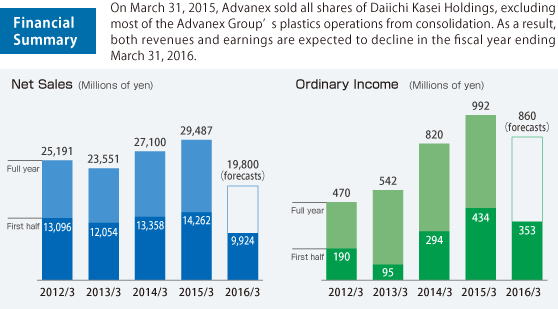

The sale of all shares of Daiichi Kasei Holdings Co., Ltd. caused a sharp drop in both revenue and earnings in H1 compared with the same period of the previous fiscal year (YoY). Even so, we succeeded in meeting our forecast of business results. I attribute this success to the hard work and dedication of all employees toward meeting these targets. Favorable results in sales for automotive and medical-equipment applications were also factors. On the other hand, we had been expecting to return to manufacturing in Japan amid the depreciation of the Japanese yen, but decreased results in office automation continued to present headwinds for this effort.

The automotive market generally has entered an environment of exceptional challenges, most notably including the economic downturn in China. Fortunately, a number of developments are pointing Advanex in a favorable direction. First, we are expanding sales channels with Japanese, American and European automakers, as well as with local manufacturers in China. Second, as advances such as plastics with improved heat-resistance and strength become available, the shift from metal to plastic auto parts is accelerating, driving rapid growth in orders for insert collars (reinforcing parts for plastic fasteners), a strategic product of Advanex. Finally, precision springs for automobile manufacturing require high durability, as they are subject to secondary processing such as grinding and inner-surface chamfering. Our Saitama Plant is equipped to respond to this need, so we expect to be able to differentiate Advanex from its competitors in this respect.

On the medical front, we are focused on specific customers in the United Kingdom. Sales volumes for asthma inhaler kits incorporating Advanex components are growing, paced by expansion in the market for simple therapeutic medications. The Company anticipates long-term growth in this market, as the ranks of purchasers continue to multiply in emerging markets such as China and South America, so we expect stable revenues from this field going forward. Also, we have recently won orders from major medical-equipment manufacturers in Japan.
In infrastructure, we have great hopes for LockOne. Because it is a product that will be adopted in public-works projects, certification is required on the prefectural and other levels, so it will take some time before we can expand sales in Japan. Overseas, however, we have already received firm orders for applications in building projects and railways. LockOne can even be used on the International Space Station, so it truly is a product for which we have great ambitions.

Construction of Saitama Plant was completed on November 2, 2015. We will spend December creating test samples and then gradually phase in production from March to summer 2016. We've already hired 15 employees for Saitama Plant and these personnel will work with employees from Niigata Plant to get the facility up and running. Saitama Plant is built on the concept of a "smart plant," in which the number of workers is kept to the barest minimum from receiving of materials to product shipment. The background to this concept is wage inflation in Asia ex-Japan. Once we establish the necessary expertise in smart-plant operations in Saitama, we will introduce the concept to overseas plants in sequence, to respond to the problem of rising labor costs.

They are. Funabashi has recently begun production of deep-drawing parts for the automotive sector in small lots, and large orders have been confirmed for 2017 and 2018. Our plans had called for completion of phase two at Saitama Plant around 2019, but we may need to move that schedule forward. Also, in addition to parts for the auto sector, orders for machine and medical-equipment parts have been confirmed. On the other hand, inquiries for mobile-telephone antennas, which were previously a mainstay product for Advanex, have shriveled even faster than expected, as viewer demand for 1SEG [a mobile digital broadcasting service] has dried up.
We recently implemented the latest software for deep-drawing, which will enable us to conduct simulations of molds. This innovation is expected to slash production lead time. Not only will the endless reworking of molds become a thing of the past, but we will also be able to offer quicker estimates, which will no doubt make customers happy.

This fiscal year we appointed two outside directors, Tomoyasu Ozeki and Seiichiro Yonekura, and one outside auditor, Jun'ichi Shukuwa. All three of these corporate officers fly overseas frequently, as they understand the importance of on-site inspection, and offer particularly valuable and specific opinions on overseas strategy. The outside directors ask questions and offer opinions without reservation about the Company's products, strategy and other issues, which serve as catalysts for deeper discussions and contribute to lively and productive discussion at meetings of the Board of Directors.
On March 31, 2015, Advanex sold all shares of Daiichi Kasei Holdings, excluding most of the Advanex Group's plastics operations from consolidation. As a result, both revenues and earnings are expected to decline in the fiscal year ending March 31, 2016.

In the current fiscal year we are opening sales offices in Stuttgart, Germany; Pune, India; and Tianjin, China. We will also open a factory in Querétaro, a suburb of Mexico City, Mexico. Most of those facilities will take aim at demand for automobiles. Many automakers and primary suppliers have already established bases of operation in Mexico, but secondary suppliers such as Advanex are still thin on the ground. We hope that by establishing a presence early we can capture much of the demand in this market.
In or after the next fiscal year, we intend to open a factory in the Czech Republic. The Czech people are similar to the Japanese in many ways, persevering and orderly. Before World War II, Czechoslovakia, as it was then, was an industrial powerhouse with a high level of technical sophistication. It was considered an ideal place to build a production site in Europe. In contrast, we had also planned to establish a base in Brazil, but the infrastructure is less developed than we expected and our customers have not yet committed to a presence there. We are currently considering the matter carefully. Finally, we are also considering acquisitions of factories overseas.

We had planned to reduce net interest-bearing debt to zero by 2020. As our financial constitution has improved, however, the interest rates we have to pay have dropped and financing has become easier. As a result, we are now considering placing higher priority on investment. Should we decide to do so, we expect net interest-bearing debt to remain static.