Thailand is often called "the Detroit of the Orient," as she is the largest hub of automotive industry in Southeast Asia. This country enjoys close ties to Japan, from which she received 60% of her inward investment in 2013.
The extensive flooding that struck Thailand in 2011 was widely reported in Japan. Like many Japanese-affiliated companies, Advanex Thailand suffered damage in this disaster. Despite this unfortunate event, however, Thailand remains a country much loved by the Japanese people. Thailand is a strongly pro-Japanese nation, and her gentle national demeanor has earned this kingdom the nickname "Land of Smiles." Today Thailand remains a vital base of operations for numerous Japanese-affiliated companies.
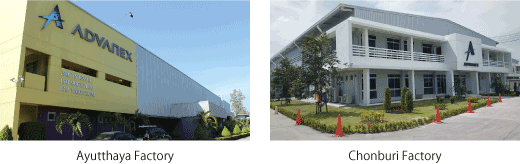
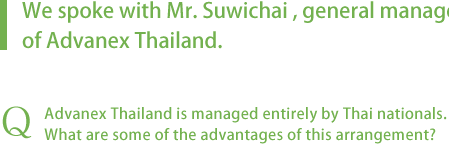
Advanex Thailand possesses two production facilities, both within an hour's drive of Bangkok, the capital. One of these is located in Ayutthaya Province, site of the ruins of Ayutthaya, a UNESCO World Heritage site. The second is sited in Chonburi Province, a center of automobile-manufacturing operations. Together the plants employ some 200 workers.
Like Advanex' other overseas bases, Advanex Thailand shares the policies of the Advanex Group but is managed by local personnel. The entire management class, up to and including the president, consists of Thai nationals. Currently two Japanese nationals are employed at the company in a supporting capacity. Among the companies of the Advanex Group, Advanex Thailand has one of the highest levels of automotive sales as a proportion of total sales. Of ¥1.6 billion in net sales in FY2014, over half consisted of sales to the automotive sector.
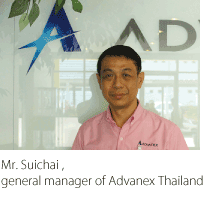 At most of the other Japanese-affiliated companies, the entire management staff from the president down are Japanese. Communication is either done in English or through an interpreter, making it difficult to establish communication with the local employees, most of whom don't speak English. At Advanex Thailand, all management staff, including our president, Mr. Ron , are Thai nationals. Everyone understands the Group policy accurately, including general workers, which is a major advantage. In recent years, our Japanese-affiliated corporate customers have also been progressively reducing reliance on Japanese staff in favor of Thai nationals, so this policy is becoming increasingly advantageous in communicating with customers.

Around 2003 Advanex established a policy calling for expansion of our business with the auto-manufacturing sector. At that time over 80% of Group sales were dependent on office-automation equipment and consumer electronics, and we felt the need to distribute market risk more widely.
Sales to the automotive sector were almost non-existent for us then, so securing new contracts with auto-parts makers was a challenge for us, as these companies focus strongly on track record. With the cooperation of Japanese resident staff, we approached Thai contact persons with patience and tenacity. At last the breakthrough came with our first order from a local company through a Thai contact person. Though initial volume was small, order sizes grew as the customer gained confidence in us. Today orders have expanded so much that this customer uses over 40 parts supplied by Advanex Thailand for just one model.

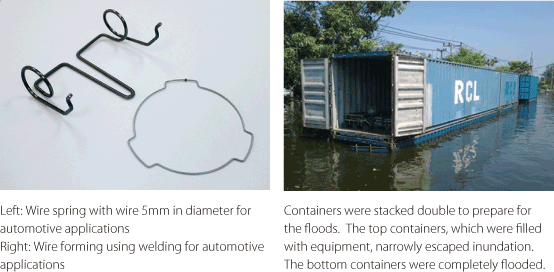
We are introducing large, thick springs for applications such as seats and steering assemblies. Prices are about 10 times those for general consumer-electronics applications, so margins are reasonably good. We are also bringing in new technologies such as welding and shot peening*, to increase value-added and expand business opportunities.
* A processing technology in which large numbers of steel or nonferrous pellets are bombarded at a metal surface at high speed. This process enhances material strength by leaving rounded depressions on the surface.

(Sighs deeply) There are too many of them. I hardly know where to start! One thing that deeply impressed me was how many employees stayed together at the plant through the crisis to protect it, even though their own homes were being destroyed. Regardless of duties or position, everyone lent a hand to the best of their ability.
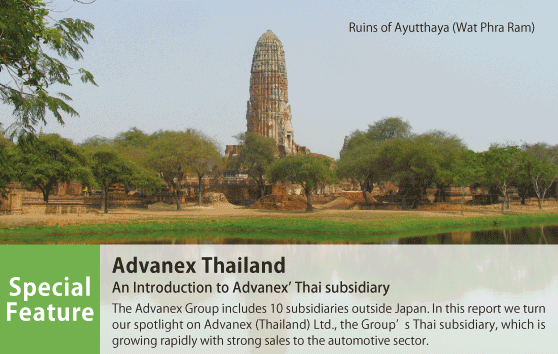
By the time the floodwaters were drawing near, the moving companies all had their hands full. We had to do all our haulage ourselves. As time ran short, the work became dangerous, but somehow we were able to haul away the minimum necessary materials to complete delivery on time so that we could restart production. We didn’t have time to save all our materials and equipment, however, so we piled one container on top of another, loaded the top containers, and waited for the dirty water to arrive. The containers were 3m high, so we thought they would be high enough, but the bottom container became completely submerged. I became very worried. We had to make snap decisions on several occasions, but head office supported us while letting us make the necessary decisions. In the end we succeeded in keeping damage to a minimum.