What are some of the experiences you remember from your youth?
When I was young, there were no factories that produced springs using computer control. The first Advanex facility to implement such a system was the old Fukushima Plant. We started without any textbooks to follow or any expertise in the subject, so we were fumbling in the dark at first. Some of the longer-serving employees and I devised original methods and a style of our own. It was a lot of fun.
Another incredible experience was building an automatic packager all on our own. At Fukushima Plant at the time, we had a fully automated line for floppy-disk shutters that performed automatic packaging, but wire-spring packaging, which is what I was in charge of, was still manual. I wanted to free my seniors at the plant from the drudgery of stuffing floppy-disk shutters into boxes using tweezers all day long. I learned by watching the process. Being assigned to engineering despite my general educational background, I had to learn everything from scratch.
What are the advantages and characteristics of Koriyama Prototype Center?
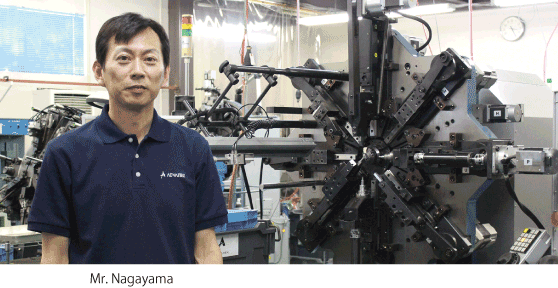
The Koriyama Prototype Center is small in scale but it’s a vital technology-development facility where all our wire-spring technology and equipment is concentrated. We can handle all processes from material receiving through tempering to performance and quality inspection here, so we can handle customer requests on the spot for even the most subtle corrections and changes.
Do you have a motto, and if so what is it?
I don’t have my own motto, but the Advanex approach to manufacturing is “build the prototype the same way you’re going to build the mass-production system.” Most companies typically build prototypes by hand, then design manufacturing processes for the shift to mass production. At Advanex, even to produce a single prototype we fashion the tools and write the production software for it, duplicating the systems that will be used in mass production. This approach allows us to test the quality of the mass-produced product at the prototype stage. The mass-production processes and code we develop here can be deployed as they are at Niigata Plant and other plants, enabling highly efficient production from order acceptance to mass production and quality control.
What kinds of prototypes are the most difficult?
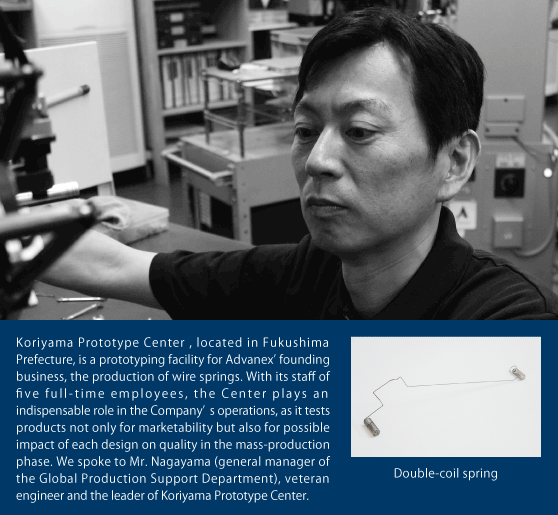
I’ll never forget the time we developed a double-coil spring. Conventional springs are made by bending and winding wire. But with materials of this shape, we aren’t able to wind the elongated wires themselves. After much trouble and frustration, we hit on the idea of tackling the problem the other way around, by fixing the wire in place and rotating the machine. With this approach, the double-coil spring was born. Recently, we’ve created springs with an unusual shape, consisting of a spring wound onto a rod-shaped wire. This type of spring, which is used in parts for fishing tackle, was quite a challenge to develop.
Why did you develop such unusual ideas?
The machinery we used to use couldn’t produce the complicated shapes we can today. Sometimes we would work our way through repeated trial and error only to give up at the end. I’ll never forget the way we used to scratch our heads, trying this and that approach and meeting frustration after frustration. We would look at the plan drawings and remember something about them just then, and a solution would come into focus. Now we have high-performance machinery that can process shapes that were previously infeasible. But machine performance isn’t everything. The accumulation of experience brainstorming various problems is an important contribution as well.
Finally, what does the term “artisan” mean to you?
An artisan is one who never sets limits, always pushing forward and aiming for higher things. I’m not sure I should call myself an artisan, but even now I’m still trying to push back the frontiers.